
Reviewed · WORKSHOPS
Kiteboarding Lessons in Punta Cana
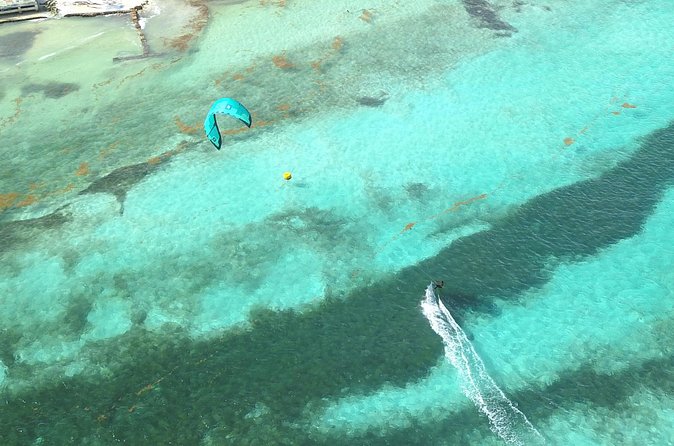
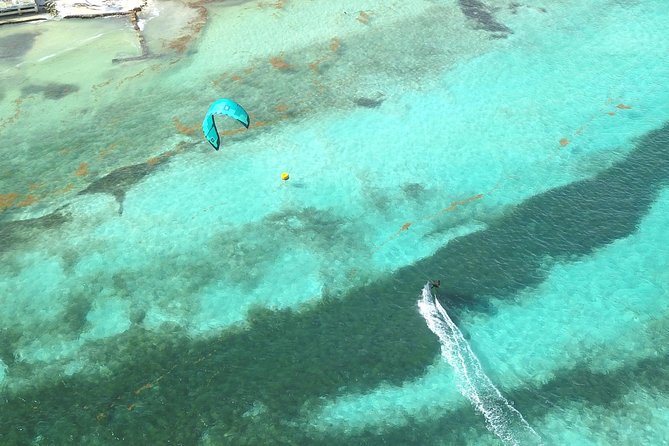
Punta Cana’s trade winds make it one of the Dominican Republic’s best places to learn kiteboarding. This course takes you from wind theory and a small trainer kite to full-size equipment, body dragging, and your first waterstarts, with instruction shaped around your ability.
I like the small four-person limit, which gives you more useful coaching than a crowded beach lesson. I also like the step-by-step structure, plus the chance to practice in shallow water at spots such as the area near Pearl Beach Club. The main drawback is simple: kiteboarding depends on wind, and even a three-day booking cannot promise that you will be riding confidently by the end.
I also appreciate the flexible format. You can book one, two, or three days, with three hours of teaching each day. Humberto is the main instructor named in the information provided, while Felix, Nelson, Marino, Cuco, and Seguin have also been involved with lessons. Confirm the exact instructor, meeting point, and transport option before you go.
In This Review
- Key points before you book
- Why Punta Cana works for a first kiteboarding lesson
- Day one: wind theory, safety, and the trainer kite
- Day two: full-size kite control and body dragging
- Day three: board recovery, riding both directions, and waterstarts
- The instructors and the teaching setup
- What the $215.39 price means
- Weather, scheduling, and the practical catch
- Who will get the most from this course
- Final verdict: book it if you want a real introduction
- FAQ
- Is previous kiteboarding experience required?
- How long is each lesson?
- How many people can join the course?
- What does the course teach?
- Is hotel pickup included?
- What happens if bad weather cancels the lesson?
Key points before you book
- Three-hour daily classes: Choose one, two, or three days, giving the full course about nine hours of instruction over three days.
- A real beginner progression: You start with wind theory and a trainer kite before handling a full-size kite in the water.
- Groups capped at four: This is a useful size for individual corrections and close safety supervision.
- Punta Cana water practice: Shallow, relatively calm water near Pearl Beach Club can make early lessons less intimidating.
- Strong coaching tools: Some sessions use a two-way radio system, and one account also describes drone footage for checking progress.
- Weather matters: The school operates in all weather conditions, but poor weather can lead to a new date or a full refund.
Why Punta Cana works for a first kiteboarding lesson
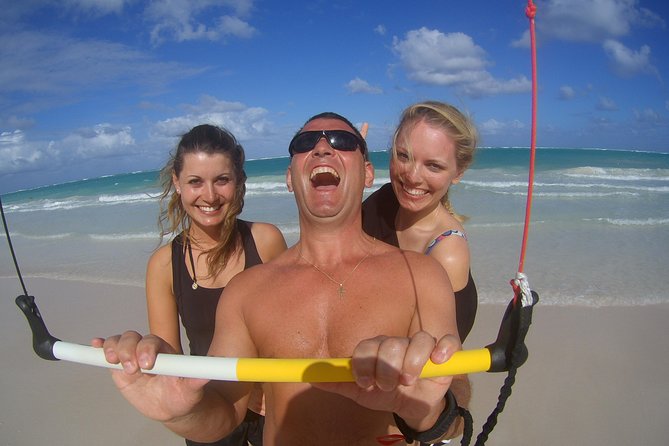
Kiteboarding looks simple from the beach. A person holds a bar, a large kite pulls across the wind, and a board skims over the water. In practice, you are managing wind direction, kite position, safety systems, body position, and board control at the same time.
That is why a lesson is a better starting point than renting equipment and trying to copy someone nearby. The course begins with wind theory and the wind window, the basic area in which the kite can move. You learn where the kite creates power, where it loses power, and how small steering movements affect the pull.
Punta Cana is useful for this kind of teaching because the course can move between beach instruction and water practice. Accounts of the school’s sessions describe knee-deep water and flat conditions near Pearl Beach Club, though exact conditions will change with the day and location.
For you, the key point is not simply the tropical setting. It is having enough open water to make mistakes without immediately turning every mistake into a hard fall. You still need a moderate level of fitness, and you should expect repeated practice rather than instant success.
A few more Punta Cana trips worth weighing up
- Macao Beach Private Surf Lessons
★ 5.0 · 139 reviews - Group Surf Lessons Punta Cana – Fun, Easy & Beginner-Friendly
★ 4.5 · 121 reviews - Chocolate Master Class & Taino Concept Store
★ 5.0 · 43 reviews
Day one: wind theory, safety, and the trainer kite
Your first day starts at the academy, where you meet the instructor, get suited up, and listen to a safety briefing. The supplied information specifically includes helmet use, but food and drinks are not included, so plan your day around your own refreshments.
The first lesson is built around control. You learn how the wind behaves, how the kite sits in the wind window, and how the equipment fits together. This may sound like classroom material, but it is the part that keeps the sport from becoming a tug-of-war with a large kite.
You then work with a trainer kite. It is smaller and easier to control than the full-sized kite used later, making it a sensible tool for learning the basic steering movements. You practice piloting it and steering with one hand, which begins to build the coordination needed for the bar and kite.
This first session is also where the instructor can see how quickly you process directions. Humberto is repeatedly described as patient and clear, with a teaching style that uses demonstration and correction rather than simply handing over equipment. Some accounts also describe radio communication during the lesson, allowing the instructor to give directions while you are on the water.
Do not judge your progress by how quickly you can launch the trainer kite. The real value of day one is learning how to reduce power, respond to a mistake, and keep the kite under control. Those skills matter more than a dramatic first run.
Day two: full-size kite control and body dragging
The second lesson moves you to a full-sized kite and more active water work. This is often the point at which the sport begins to feel real. The kite has more power, and your timing matters much more.
You practice a water relaunch, which means getting the kite back into the air after it falls onto the water. You also work on downwind body dragging. In this exercise, the kite pulls you through the water while you learn how to steer your body and manage the kite without yet relying on the board.
Body dragging can feel less glamorous than riding, but it is one of the most useful safety skills in the course. If you lose your board, you need a controlled way to move through the water and retrieve it. You also learn how the kite pulls your body, which helps prepare you for standing on the board.
The school’s equipment has been described as modern, with a range of kite sizes. That matters because kite size needs to match wind strength and the rider’s weight. The right equipment makes learning more manageable, though the final choice belongs to the instructor and the conditions on the day.
This is also where the group limit matters. With no more than four people, you should have a better chance of getting corrections while you practice rather than waiting through long turns. The lesson is still shared, so a private session may suit you better if you want constant one-to-one coaching or have limited time.
Day three: board recovery, riding both directions, and waterstarts
The third day introduces more complex skills. You work on upwind body dragging, a technique used to recover the board when it has moved away from you. Unlike downwind body dragging, this requires more control and a better feel for the kite’s position.
You then work toward riding the board in both directions. This is a major step because many beginners can manage one short run but struggle when they need to change direction or reset their position.
The first waterstarts are the main goal of this session. A waterstart is the movement that gets you from sitting in the water to standing on the board while the kite provides enough pull to carry you forward. It takes timing. Pull too hard with the kite and you may lose control. Move too slowly with the board and the kite may not have enough power.
The course does not promise that every person will complete a polished waterstart. Wind, body size, previous board sports, confidence, and the amount of time spent practicing all matter. If you are a complete beginner, I would view a successful first waterstart as a bonus and solid kite control as an equally valuable result.
A two-day course may be enough for someone with prior kiteboarding instruction or related board-sport experience. If you have never handled a kite and want time to repeat each skill, the three-day option offers a better chance to build a base without rushing.
A completely different sort of day out of Punta Cana:
- Adventure Bundle: Monkeyland, Ziplines & Buggies Punta Cana
★ 5.0 · 10,715 reviews - Private Airport Punta Cana to La Romana Bayahibe or Casa de Campo Resort Area
★ 5.0 · 6,662 reviews - Punta Cana Zipline Adventure with Buggies and Horseback Riding
★ 5.0 · 5,001 reviews - Full-Day Santo Domingo City Tour from Punta Cana
★ 4.5 · 4,500 reviews
The instructors and the teaching setup
Humberto is the instructor most closely associated with the school in the supplied details. He is described as an IKO instructor in one account, and the teaching approach emphasizes safety, clear demonstrations, patience, and frequent corrections.
Other instructors named in connection with lessons include Felix, Nelson, Marino, Cuco, and Seguin. The exact staff working on your dates may vary, so it is sensible to confirm who will teach your session when you book.
A two-way radio system called BBTalkin is described in some sessions. If available for your lesson, this lets the instructor give short instructions while you are away from the beach. That can be especially helpful after your first waterstart, when the instructor cannot stand beside you and explain every adjustment.
One account also describes the use of a drone to record performances and follow progress. Treat this as a possible extra feature rather than a guaranteed inclusion, since the formal inclusions name only a professional guide and helmet use. If video matters to you, ask before arriving.
The school has also helped arrange transport or alternate instruction in some cases, but hotel pickup and drop-off are not automatically included unless you select that option. The stated meeting arrangement is to make your own way to the academy in La Altagracia Province.
What the $215.39 price means
The advertised cost is $215.39 per person, but the course comes in one-day, two-day, and three-day versions. Because the supplied details do not spell out which duration that price represents, check the final booking screen carefully before paying.
The best way to judge the value is by looking at instruction time. A three-day course gives you about nine hours of lessons, three hours per day. That is a meaningful amount of supervised practice for a technical sport, especially with equipment and a helmet provided.
The group maximum of four improves the value compared with a large class. You are not paying only for beach orientation and a quick equipment handoff. The course covers theory, safety, trainer-kite handling, full-size kite control, body dragging, board recovery, and waterstarts.
Still, this is not an all-inclusive beach outing. Food and drinks cost extra. Transport also costs extra unless you select the pickup option. You should budget for those items and allow enough time to reach the meeting point.
I would consider the three-day option the strongest value for a first-timer who has room in the schedule. The one-day course makes more sense if you want to test the sport, while two days can work well for a refresher or someone with previous lessons.
Weather, scheduling, and the practical catch
The school operates in all weather conditions, but kiteboarding itself needs suitable wind. Poor weather can cancel the activity, in which case you are offered another date or a full refund.
That policy is useful, but it does not remove the scheduling problem. A person with only one free afternoon has less flexibility than someone staying in Punta Cana for a week. If kiteboarding is important to you, leave room in your itinerary for a weather change.
The course is booked, on average, six days ahead. That gives you a rough planning guide, but wind sports can also be affected by instructor availability and the number of people already scheduled. I would reserve before arriving if your holiday dates are fixed.
You should also dress for outdoor conditions and bring what you normally need for a long beach session. The official information says to dress appropriately for the weather. It does not list meals, drinks, or hotel transfers as standard inclusions.
Free cancellation is available up to 24 hours before the start time for a full refund. Changes or cancellations inside that 24-hour window are not accepted for a refund, except when the school cancels because of poor weather.
Who will get the most from this course
This course suits complete beginners, casual adventurers, families, and returning riders who need to rebuild their confidence. Several accounts describe adults learning for the first time, while another describes a parent and child taking lessons together.
You do not need previous kiteboarding experience. You do need moderate physical fitness and enough patience to repeat a movement many times. You will handle equipment, swim or move through the water, and react to changing kite power.
The small group should appeal to you if you want personal instruction without paying automatically for a private lesson. You can ask questions and receive corrections, but remember that four people still share the instructor’s attention.
Advanced riders may find the beginner progression too basic unless they choose a refresher or private session. The school has also handled advanced lessons, including sessions in strong wind, but you should state your level clearly when arranging the course.
This is less suitable if you want a passive sightseeing trip or a guaranteed ride on the first day. Kiteboarding is physical, technical, and weather-dependent. The reward is learning a real skill, not simply being pulled across the water for a few minutes.
Final verdict: book it if you want a real introduction
I would book Kiteology DR if you want to learn the foundations of kiteboarding in Punta Cana and can give the sport at least two or three days. The best parts are the careful progression, small group size, shallow-water practice at suitable spots, and instructors such as Humberto who focus on safety and direct correction.
Choose one day if you are curious and want a first look. Choose two days if you have limited time or previous instruction. Choose three days if you are starting from zero and want the best chance to reach body dragging, board control, and early waterstarts.
Before you pay, confirm the duration covered by the $215.39 price, the meeting location, the instructor, and whether hotel pickup is included in your selected option. If the wind fails, the refund or alternate-date policy gives you a reasonable safety net. Just do not confuse a kiteboarding course with a guaranteed beach thrill. You are signing up to learn, practice, fall, reset, and slowly begin to ride.
FAQ
Is previous kiteboarding experience required?
No. The course is suitable for complete beginners as well as more experienced riders who want to improve their skills.
How long is each lesson?
Each daily class lasts approximately three hours. You can choose a one-day, two-day, or three-day course.
How many people can join the course?
The activity has a maximum of four participants.
What does the course teach?
The first lesson covers wind theory, the wind window, equipment use, trainer-kite control, and one-handed steering. Later lessons cover full-size kite control, water relaunches, downwind and upwind body dragging, board recovery, riding in both directions, and waterstarts.
Is hotel pickup included?
Hotel pickup and drop-off are not included unless you select an option that includes transport. Otherwise, you make your own way to the Kitesurf Academy in La Altagracia Province.
What happens if bad weather cancels the lesson?
You can be offered a different date or a full refund if the activity is canceled because of poor weather. You can also cancel for a full refund if you do so at least 24 hours before the scheduled start time.
Just added around Punta Cana
- Half-Day Punta Cana Booze Party Cruise Experience★ 4.0 · 4 reviews
- Muddy ATV Eco-Adventure from Punta Cana★ 4.0 · 4 reviews
- 3 Days Open Water Diving Course in Punta Cana★ 5.0 · 4 reviews
- Private Fishing charter Punta Cana (Alondra)★ 4.0 · 4 reviews
- Punta Cana Buggy or ATV Adventure to Macao Beach and Taino Cave★ 4.0 · 4 reviews
- SANTO DOMINGO/ City tour – the best Adventures & traditional★ 5.0 · 4 reviews
- Private Transfer for Puerto Plata★ 4.0 · 4 reviews
- Punta Cana: Tour in buggy From Hotel impressive Punta cana★ 3.6 · 4 reviews
Workshops, compared.
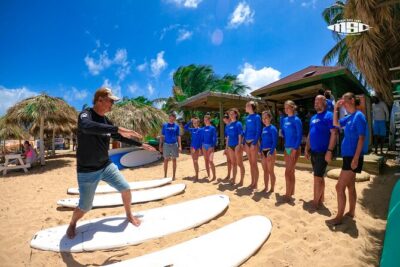
Group Surf Lessons Punta Cana – Fun, Easy & Beginner-Friendly
Read our review →
Saona Island VIP 4 first-class beach and sunset
Read our review →
Private Surf Lesson Punta Cana – 1-on-1 Coaching for All Levels
Read our review →
Full-Day Surf Camp in Punta Cana –Lessons, Beach Time & Adventure
Read our review →Browse the lists this tour appears in